 Skip to content
At Grand Studio, our mission has always been to collaborate with organizations as they address complex challenges. Recently, there’s been a strong shift in our discussions with executives and People Leaders, reflecting widespread concern about how AI will reshape work and affect employees. We are seeing that many organizations are rapidly adopting AI tools to improve efficiency and protect margins, often without a clear plan for the impact on their workforce..
In response to this challenge, Katie Palmer, our Chief People Officer for the last 8 years, has spent much of her time guiding our design team as they internally experience these digital transformations, often determining through trial-and-error best practices to address the main challenge that is frequently not the AI itself, but managing the rollout and change. Through this learning, she understands well that without creating clear guidelines and a human-centered design, employee experience can be compromised for efficiency. So in this blog, she’ll share more tips and ideas about how to ensure AI adoption succeeds because trust, clarity, and culture are protected.
AI and people operations: the real challenge
After years of leading teams in IT and consulting, what really worries me isn’t an AI robot takeover, but a growing reality: as organizations rush to optimize by pushing staff to move faster, cut costs, and increase efficiency, they accidentally erode the human connections that make workplaces successful.
New tools are fundamentally changing how HR operates. AI tools are being introduced to help HR streamline everything from recruitment and planning to communication, performance management, and team support. While some changes are overdue, the modern workplace remains complex. Employees expect intuitive tools, and leaders face increasing administrative demands.
Many HR teams have already implemented AI into their processes through resume-parsing algorithms, AI-driven sentiment analysis, and predictive analytics, and it’s getting harder to tell where the tool stops helping and starts deciding. Leaders are leaning on algorithms for calls that really need a human in the room: using AI agents to data mine, conduct screening, and decide who passes through the pipeline to get hired. Not to mention leaning on AI for layoffs and terminations, using productivity data that has not been evaluated for bias. And when a system quietly screens out a candidate or flags someone as ‘high risk,’ it’s easy for leaders to just defer to it instead of actually thinking it through.
This approach to people strategy could remove empathy and create a huge systemic risk. We all know this, but with the push for AI integration, people ops seems to be forgetting that AI learns from historical data sets, so it codifies and amplifies past human prejudice.
The legal risk no one is talking about
AI adoption also carries a growing legal dimension that leaders cannot ignore.
The U.S. Equal Employment Opportunity Commission (EEOC) and the Department of Justice have made it clear that employers are responsible for employment decisions, even if AI tools influence them.
AI systems learn from historical data. If that data reflects existing patterns of bias, inequity, or exclusion, those patterns are enforced and scaled through automated processes.
Organizations should explore the following when thinking about adopting a new AI tool into their HR process:
- Does the tool disadvantage candidates with disabilities? For example, video-interview or gamified assessments that penalize speech patterns, eye contact, or reaction time in ways unrelated to job performance.
- Does our vendor contract give us audit rights, data access, and indemnification, or are we accountable for a system we can’t actually inspect?
- Are we compliant with the laws that apply to us: NYC’s bias audit law for automated hiring tools, Illinois’ AI video interview law, or similar rules wherever we operate?
- Does this tool produce a statistically measurable adverse impact on any protected group under the EEOC’s four-fifths rule, and has anyone actually run that analysis?
- Who owns ongoing monitoring once the tool is live? Bias doesn’t just get checked once at launch; it needs to be re-tested as the model and applicant pool change.
- Can we explain a rejection to the candidate or employee it affects? If the vendor’s model is a black box even to us, we can’t legally meet our own disclosure obligations.
While technology vendors supply the tools, employers retain full accountability for their use.
The cost of moving too fast
People operations is more than process execution and policy enforcement. Successful organizations thrive by actively:
- Building and maintaining deep internal trust
- Nurturing a strong, lived, and breathable culture
- Rallying around a clear, compelling, and shared vision
- Building a place where people feel safe speaking up and actually feel like they belong
If you want real alignment and sustainable growth, you can’t outsource any of these core actions to an algorithm or a software vendor. Technology can support HR operations and logistics, but it can’t replace human judgment, empathy, context, organizational values, or emotional nuance.
When leadership teams forget this truth, the day-to-day experience of work can feel cold and impersonal, or as if nobody actually cares.
I’ve seen how easily this can happen: an HR tool integrated a new AI function to help with feedback and reviews. The model pulled information from 1:1 discussions with managers and incorrectly mapped it to employees for performance reviews. Without human oversight and clear governance on AI tools, something as simple as a new software update can quickly erode trust with managers and weaken 1:1 relationships in organizations.
Your employees notice when a message feels like it came from a bot, when decisions don’t make sense, and nobody can explain why, or when tech is being used to watch them instead of help. If that is the norm, trust erodes; the whole place starts to feel less like a team and more like a transaction. It also breeds a culture of defensiveness, because people know the system could misrepresent them at any moment over a small misunderstanding or a sweeping generalization.
Whatever temporary gains you score on the balance sheet will be rapidly wiped out by the compounding cultural damage. When organizations treat humans like variables in an optimization equation, using algorithms for hiring, performance management, or employee monitoring, engagement plummets, psychological safety erodes, and your best talent quietly checks out.
They deserve to be heard, treated fairly, and led with genuine empathy and honesty. Your teams are still starved for human leadership.
Tech Cheerleader:
The new responsibility of people leaders
As HR executives in the modern landscape, we can’t stick our heads in the sand. Our candidates are already using these tools, our employees are quietly experimenting with them, and the C-suite is aggressively asking how to roll them out to protect margins.
While AI is driving the urgency today, this challenge extends to our entire technology ecosystem, from our HRIS platforms to automated recruiting systems and sentiment trackers. Balancing efficiency with empathy requires People leaders to master two interconnected skill sets: Technical Fluency and Human Fluency.
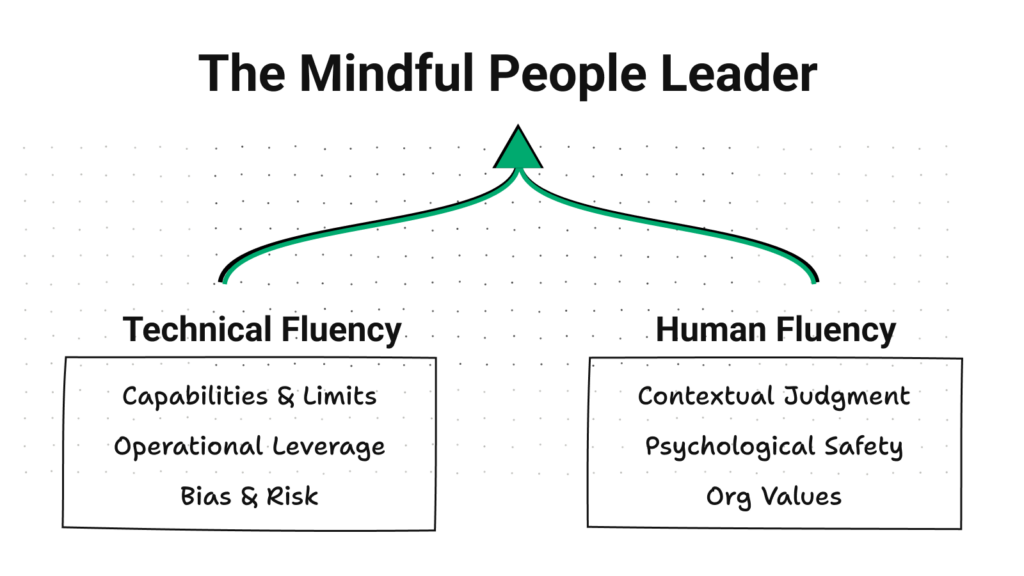
Rather than viewing these as opposing sides of a brain, think of them as complementary capabilities:
- Technical Fluency (Understanding Capabilities & Limits): This isn’t about learning to code. It means developing a grounded, realistic understanding of what software and AI models actually do, where they generate genuine operational leverage, where their training data creates compliance or bias risks, and where their output degrades.
- Human Fluency (Context, Empathy & Culture): This is the ability to interpret nuance, navigate emotional complexity, build psychological safety, and uphold organizational values, qualities no software vendor or algorithm can replicate.
The intersection of these two fluencies is where true leadership lives. It is precisely because you understand a tool’s capabilities and limitations (Technical Fluency) that you can accurately determine where human oversight, contextual judgment, and emotional presence must remain non-negotiable (Human Fluency).
When HR leaders actively lean into technology with this dual perspective, they do more than just streamline processes; they transform the organization’s energy.
By taking the lead on these tools, they give their teams the gift of time, replacing tedious administrative friction with space for deep, meaningful work. Ultimately, this tech-forward approach builds an adaptable workforce that feels supported rather than policed, proving that modern innovation can actually make a culture feel more human, not less.
A simple test for People leaders:
Before automating a process, ask:
- Would an employee reasonably expect a human conversation?
- Could the outcome materially impact someone’s career?
- Does this interaction require empathy?
- Does it require contextual judgment?
If the answer is yes, AI should support the process, not own it.
Automate the “busy” work
The employee lifecycle remains our most grounding framework for thinking about the people experience. As conscious people leaders, we have to pause, take a deep breath, and ask a much harder question: Just because we can automate a human interaction, should we?
When applied mindfully, the right tech can tackle a lot of the busywork that exhausts people. The purpose of AI should be clear: offload repetitive menial tasks; never automate care, connection, or leadership.
By offloading the tactical administrative burden, technology fundamentally changes the capacity of a People team. Specifically, AI excels at taking over three main operational attributes:
- Material Creation: Drafting baseline job descriptions, training templates, and policy updates in seconds rather than hours.
- Workflow Automation: Handling repetitive routing tasks, multi-step onboarding checklists, and basic self-service FAQs without human intervention.
- Pattern Synthesis: Quickly pulling actionable themes out of hundreds of pages of employee feedback, exit interviews, or market compensation data.
By optimizing this operational work with AI, people leaders can free up time and energy for high-value, interpersonal work.
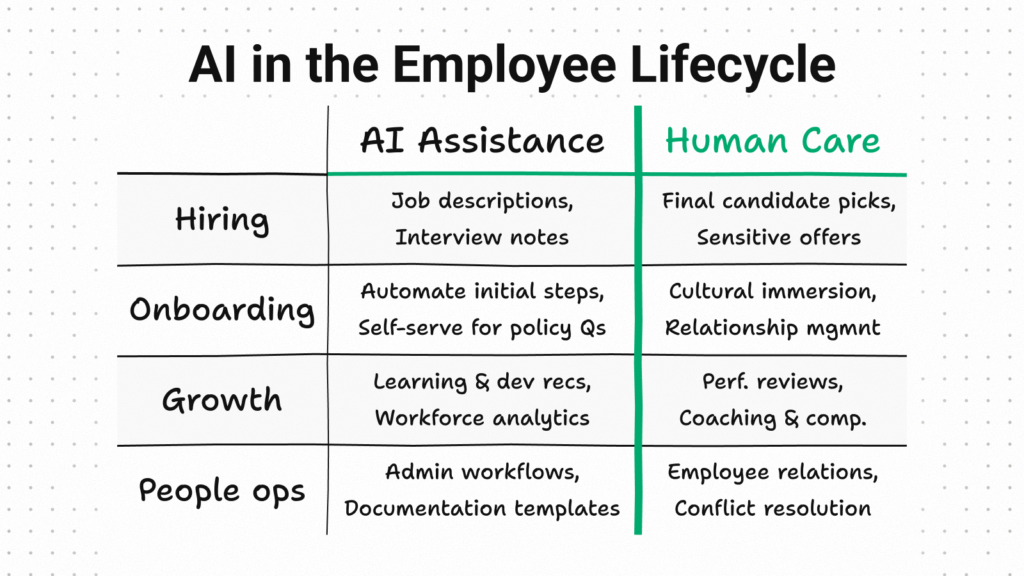
When we use automation to reduce operational noise, we intentionally preserve our HR teams’ bandwidth. This opens up the necessary energetic space for the deeply human work that moves the needle: coaching managers, designing intentional people strategies, supporting executive teams, and guarding the cultural health of our people.
What I’d tell any HR leader right now
It’s not AI versus people. It’s about using AI in a way that actually supports people. The organizations that get this right will be the ones that understand the technology well, but never let it replace the human parts of their culture.
AI will change how work gets done, but it won’t change what people need to thrive: respect, doing work that matters, being treated fairly, and a real sense of belonging. Meeting those needs will always remain a human responsibility.
The best organizations won’t automate everything they can. They’ll be smart, knowing what to automate to cut out the busywork while protecting the parts of the work that matter. Those will be the companies that come out ahead, good at tech and good to their people.
Let’s co-create your human-first strategy
You don’t have to navigate this shifting landscape alone or choose between modern innovation and culture. We partner with progressive HR leaders and C-suite executives to design custom AI readiness roadmaps, ethical governance frameworks, and intentional employee experiences that elevate your operational workflows without sacrificing your culture.
Ready to bring balance to your digital transformation?
- Connect on LinkedIn to join our ongoing community conversations around mindful, human-first innovation.
- Schedule a Focused Strategy Session to dive deep into your organization’s unique workflow frictions and culture goals.
- Book an AI Readiness Workshop for your people leadership team to align your technology roadmap with deep human values.
