 Skip to content
For two years the AI conversation has been mostly about capability: can these models do what we need to realize a valuable business ROI? Can it do it faster, cheaper, with fewer hallucinations? That race is still ongoing and it won’t be settled anytime soon, but it’s turning into a race everyone can run. Capable models are becoming table stakes now. The question that actually decides whether all that capability turns into real user value is a different one, and it is one that tech teams are overlooking in order to get these AI solutions up and running: does a human trust the output enough to act on it, and should they?
That is the core problem we are actively solving with our clients at Grand Studio. We call it calibrated trust, and we believe it’s where the next decade of AI product work leads to successes or failures. We’ve seen this before in software too (relying on business rules and big data): does it actually provide quicker convenience and improve workflow productivity to the person using it?
Our definition of calibrated trust
Calibrated trust is the fit between how much a person relies on an AI system and how much they should, given what the system can actually do in the moment in front of them. When trust is calibrated, a person leans on the AI when it’s right, understands enough to overrule it when it’s wrong, and can tell which situation they’re in.
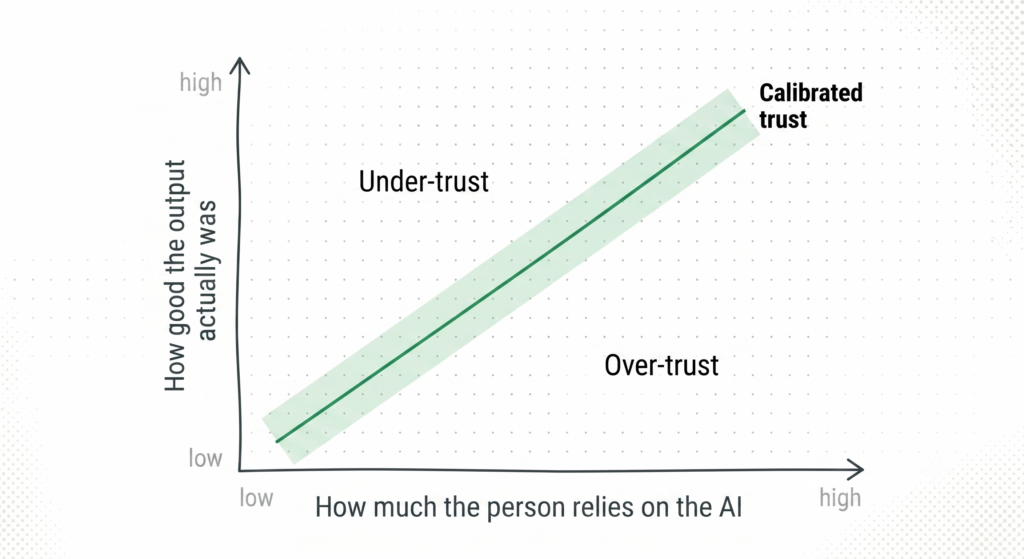
When trust isn’t calibrated, one of two failures shows up:
- Under-trust
A capable system gets second-guessed, worked around, or switched off, and the investment never pays back for the technology upgrade. - Over-trust
A person defers to an output that was wrong or unfit to the situation, sometimes at real cost, because nothing in the product gave them a reason to step back and pause. My read is that most of the industry still treats trust as a dial you turn up. It isn’t. Turned up too far and it’s as dangerous as no trust at all. The goal here is accuracy of reliance, not maximum reliance.
The reason this matters for anyone building these products is that calibrated trust should happen in the experience, not in the model. Two products can sit on the identical model and produce opposite outcomes, because one of them told the person what the system was sure about and what it wasn’t, showed its reasoning in a form the person could check, and made disagreeing with it feel native rather than like a repetitive fight. The other just showed an answer. Same accuracy on the benchmark. Completely different behavior in the room.
What it looks like when you get it right
A while back we worked on a tool for a financial services trading desk where the easy version of the product hands a trader a pricing window with the recommendation to use it. We designed the harder version. We gave traders progressive disclosure reasoning and the boundaries behind a recommendation instead of a rule to follow, and we protected their ability to read a fast-moving situation and make their own call. The design problem was never generating the recommendation itself. It was deciding which parts of the decision to hand to the system and which to leave to the user, so the tool earned a place in their hands instead of getting closed and ignored. That is a form of intentional calibration: the system carries what it’s good at, the human keeps what they’re good at, and the interface makes the handoff understandable.
In my experience the work that gets you there usually starts by overturning an assumption. On a wealth management engagement we went in expecting to improve a self-service tool, and found that neither the financial advisors nor their clients wanted a self-service system at all. They desired technology that made the human relationship between them stronger. The design had a belief baked into it about how people wanted to make decisions, and the research proved it wrong before a line of production code locked it in. The same kind of belief is usually sitting inside an AI rollout, in the form of an assumption about how much a user will trust the thing and when. Oftentimes companies have little to no plan for researching the user mindset and the barriers to adoption for these AI solutions. The assumption is that releasing the product is enough, that users will inherently understand it and adopt it on their own.
Why this is where the future is
My read is that two things are converging to push the hard AI problem from capability to calibration.
- The models are commoditizing. The gap between the best model and a good-enough one keeps shrinking, and I don’t see that reversing. When everyone has a capable model, the advantage stops being whether your system can produce a good answer and becomes whether a person will rely on it correctly, and that is a design property.
- At the same time, the stakes are climbing. AI is moving out of low-consequence suggestion and into decisions that cost something: capital allocation, credit, clinical calls, agentic actions taken on a person’s behalf. As the grave risk of a wrong move heightens, miscalibrated trust stops being a conversion problem and becomes a real one to solve. Blind user trust gets expensive, automatic distrust wastes the whole investment, and the space in between is what we feel is the real design target. It gets narrower and more important the higher the stakes go.
Underneath both is the point I keep coming back to: the inherent value of AI only ever shows up at the moment of human decision. A model runs inference in milliseconds, and none of that matters until a person does something differently because of it. Every dollar of capability sits idle until that moment, and that moment is an experience, not an algorithm. The industry has spent most of its attention on the half of the problem that ends at a correct output. The half that starts there, where a person decides whether to trust it, is still wide open and a place we believe experience design matters most.
That is where I believe this is heading. The last few years rewarded teams who could build a capable model. The next few will reward the ones who treat getting a person to rely on it well as a design problem in its own right, building calibrated trust and lasting value. Those are the products that survive and thrive.
What it takes to earn user trust
Calibrated trust is a set of design decisions about how the technology shows up at the point of a real human choice: how AI can surface its own uncertainty without gutting its value, how it makes its reasoning legible enough to be trusted and contestable enough to be corrected, how an override feels when a person disagrees, and which parts of a decision it augments versus which it leaves to the human.

The shape of the answer changes with the context. In heavily regulated work, where a decision has to survive an audit, legible reasoning is the thing that lets a person stand behind a call they made with the system’s help. In large internal tools, the difference between a feature people adopt and one they abandon often comes down to fitting the workflow and staying simple, far more than to model sophistication or perfection. Different settings, same underlying problem: designing enough thoughtfulness and care for human decision-making will lead to the appropriate level of calibrated trust.
This is the thinking behind much of our own work, including Beacon, our AI personal finance concept, built around guidance people would reasonably act on instead of another stream of alerts or blind recommendations. We are always collaborating with our clients to explore the barriers and solutions toward trust in AI products so that we can prove value to the human, and therefore value to the business.
Design for the moment of trust
You can ship an AI product that works and watch it fail. The difference is almost never the model. It’s whether you designed for the moment a person has to trust it enough to take action from it.
That moment is a tough design problem, but it’s a solvable one. It takes deep user research into where trust breaks down, interfaces that show their reasoning, and a focused plan for how people will actually adopt these AI solutions. Most teams building AI products haven’t scoped that work yet, because the field spent the last few years proving the model could produce a good answer. The next few years will reward the teams who get a person to rely on that answer well.
That’s the work we do at Grand Studio. If you’re building an AI product and the question of whether people will trust it is still open, let’s connect. We’ll help you design for the decision that actually leads to the payoff moments.
